
Creative Self-Care for Mental Health and Wellbeing
Integrated Natural Neuro-Recalibration (INNR) is an arts-based wellbeing programme.

How Does It Work?
Integrated Natural Neuro-Recalibration (INNR) is an arts-based mental health and wellbeing programme which focuses upon the naturally occurring, rebalancing processes within the brain. As an integrated mind-brain-body-environment approach, it is highly adaptable for use to build resilience, enhance creative problem-solving, or reduce symptoms in a range of mental health conditions, including depression, anxiety and post-traumatic stress disorder (PTSD).
-
The INNR program has two combined elements:
Up to twelve two-hour group sessions of singing, movement and painting in a non-challenging, arts-based context, alongside targeted neuroeducation.
Plus
Up to three one hour targeted neuroeducation sessions conducted in groups or one-to-one, identifying specific components that underlie thought processes.
-
Twelve specific, but often overlooked, creative thinking skills that can be employed to recalibrate processes in the mind.
Three layers of emotions that can be adjusted with the help of the twelve thinking skills.
The difference between personal and shared symbolic language (both verbal and non-verbal).
-
To stimulate adult human neurogenesis through focused movement and arts-based learning.
To embed and connect the new-born brain cells as seeds for alternative positive neural pathways and allow the strength of troublesome thoughts to fade and recalibrate.
Upcoming Courses 2024/25
View all coursesINNR - Wellbeing
Refresh, Restore and Renew

A sustainable programme of transferrable creative thinking skills refresh resilience, restore equilibrium and renew physical, mental and emotional reserves.
Ten weekly two-hour sessions of singing, movement and painting.
Three sessions of INNR neuroeducation.
Optional activities to practise at home.
For further information, please email info@innr.uk
-
Weekly from 12.01.24 to 22.03.24 Reserved course.
Weekly from 9.10.24 to 26.02.25. Reserved course.
Weekly 17.01.25 to 23.03.25. Reserved course.
Or by arrangement
-
Top Floor, Steiner House, 35 Park Road, London, NW1 6XT
Weston Education Centre, 10 Cutcombe Rd, London, SE5 9RJ
Verwood Hub, Brockway, Verwood BH31 7QE
Or by arrangement
-
We are also offering one to one consultations by arrangement, and taster days every three months.
If you’re interested, then please register interest here.
The Arts-Based Weekly Sessions
Twelve two-hour weekly sessions of group artistic activities will include: Singing, Movement, and Painting. These will provide practical experiences within a creative space, where participants can observe their thinking in action, both as an individual and within a social context, learning how the thinking processes involved can be gently adjusted, if that is desirable, using the Creative Thinking Skills toolkit.

Singing
Beginning with simple layered rounds and ostinatos, to balance heartrate and breathing, layer simple mental images, and differentiate pattern (predictably the same) from resonance (similar but different).

Movement
Eurythmy movement therapy to integrate simple focused body movements with the sounds of speech, mental images in two dimensions, and with three-dimensional orientation and movement in social space.
Painting
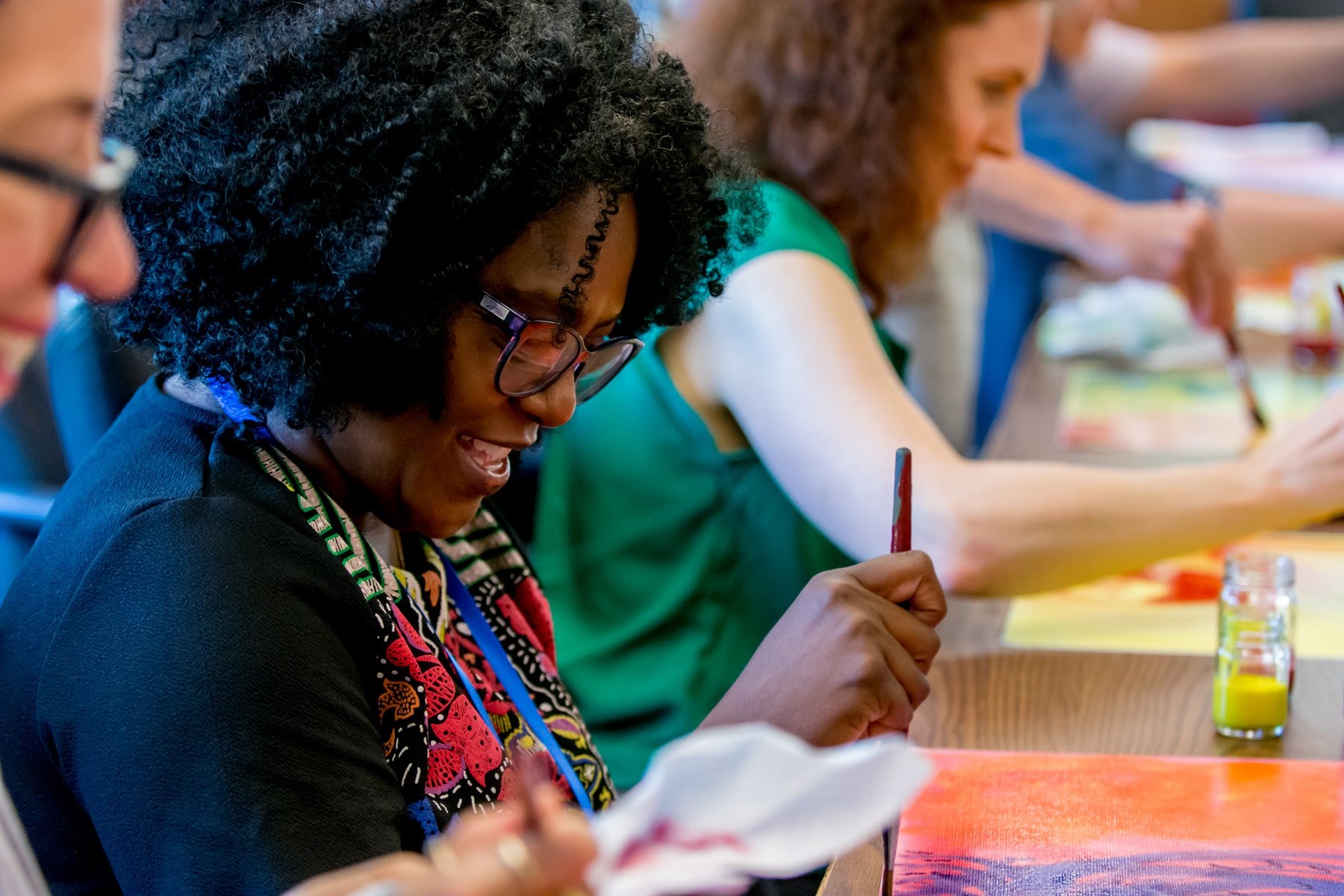
Colour Transition exercises in the wet-on-wet style of painting to stimulate, observe and expand nuanced colour perception, and integrate associations.

The Neuroeducation Consultations
Neuroeducation consultations will be focused upon the Creative Thinking Skills Framework (CTSF) of 12 thinking capacities in relation to three levels of emotion.
Together, the twelve thinking capacities enable unified thought, but can also be individually observed. They allow the mind to generate, manipulate and refine an imagination. The raw material for an imagination can be drawn from immediate perception, memory, and a multitude of collected symbolic associations and emotional responses.
Each thinking skill may be practised, just as physical skills may be. Artistic activities allow this practice to take place in a safe creative space.
The 12 Creative Thinking Skills
-
The ability to recognise, represent and place perceptions, memories, concepts and associations into predictably repeatable groupings or relationships. It is linked to everyday functioning and built upon assumptions.
-
The ability to recognise, represent and place perceptions, memories, concepts and associations into groupings, which share key characteristics, while recognising that they also differ in others. It is related to the making of meaning and the initial assimilation of the new.
-
The ability to observe both direct and indirect perceptions and associations, objectively, accurately, and at will. It is also the ability to produce an innovative approach or insight into familiar problems or accepted wisdom. It involves clarity of perception: seeing beyond assumptions, to reach the essence, the reality, or the unseen potential. It is linked to self-understanding and understanding of context.
-
The ability to generate two-dimensional pictorial imaginations that are available to be translated externally, for example into images or linguistic descriptions. It is linked to implicit associations in non-verbal personal symbolic language.
-
The ability to maintain in thought, an overview of physical or conceptual mechanisms, systems, forms, structures, or metamorphoses over time. It is also the ability to co-ordinate a variety of perspectives, including the ability to represent the point of view or experience of another person. It is linked to the experience of relationships, including empathy and self-esteem.
-
The ability to formulate appropriate spoken structure and coherence, both as a monologue and in reciprocal conversation using appropriate vocabulary and expression. It is linked to fluid modulation between personal symbolic language and shared symbolic language, within a coherent whole.
-
The ability to formulate written structure as a coherent whole using appropriate vocabulary. It is linked to shared symbolic language and to the trajectory and grammar of attention.
-
The ability to use common sense algorithmic responses or trial and error, when working with unknowns. Heuristic thinking is often an inspired attempt or a last resort in difficult circumstances. It may involve thinking through the practical application of the hands or body as whole-body thinking, or as part of instantaneous decision-making in an emergency. It is linked to crisis management, and creativity in novel situations, but requires subsequent processing to fully assimilate the experience, including any paradox that may arise in relation to normal protocols. It is linked to self-efficacy and survival.
-
The ability to refrain from judgement or prejudice when considering, for example, perceptions, associations, information or experiences, and to maintain that position for a sustained period to achieve a full, objective overview. It requires modulation of attention and is linked to post-event processing.
-
The ability to make reasoned and coherent judgements on the basis of an informed understanding. It is linked to explicit reinforcement or recalibration of associations, concepts or actions.
-
The ability to co-ordinate perceptions, associations, ideas, concepts, strategies and approaches, and manage the synergy between them, while moving between explicit and implicit thinking. It is linked to personal organisation and needs, and the associated internal and external ethical considerations relating to personal conviction or potential action.
-
The ability to objectively compare and contrast a new perception with a previously held view, experience or understanding and support or adapt one or the other. This includes perception of the thinker’s own thought processes. Where this presents a paradox, the thinker uses their perceptive ability to recognise it. It is linked to the recognition of a new reality.

Emotions
Integral to INNR is the role of emotions, which are particularly useful when described in objective terms as either:
State
Experience
Concept
Understanding emotions in these terms enables CTSF to begin to be applied to emotional responses by gently observing and adjusting their calibration.
The INNR integrated provision can give participants the tools to better observe their own constellation of verbal and non-verbal thinking skills as a whole, in practice, and in relation to their emotions and experiences.

Depression, Anxiety and Post Traumatic Stress Disorder (PTSD)
Depression, Anxiety and PTSD are complex conditions with some overlapping features. These may involve unusually strong or unusually reduced processing of certain elements in thinking. They may include intrusive or vivid images, as is often experienced in PTSD, which may be triggered by sensory perceptions such as a particular smell. A reduced perception of colour, with a heightened sensitivity to negative associations, is often experienced in depression. In anxiety, an imbalance between direct perceptions and the processing of associations can often trigger disconnected fear states that can cause great personal distress.
INNR can assist participants to address these and other troubling symptoms by triggering new thought pathways through therapeutic movement, and by exercising the associated elements of thinking in the context of the whole, to enable natural recalibration processes, which can then refresh, restore and renew physical, mental and emotional well-being.
“On with the dance, let joy be unconfined, is my motto; whether there’s any dance to dance or joy to unconfine.”
- Mark Twain